
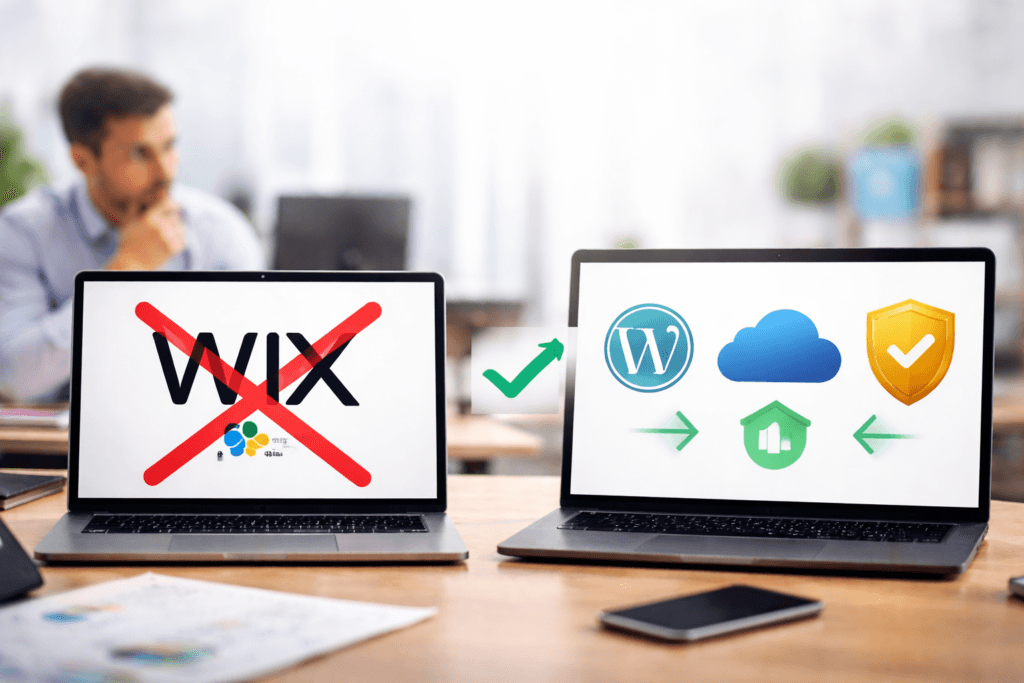
Wix may look appealing with its drag-and-drop simplicity and low intro prices, but long-term users are getting hit with shocking renewal increases, hidden fees, and zero flexibility to move their site. Here's what you need to know before you commit.
Every week, small business owners come to us frustrated. They built a website on Wix, loved it at first, and then renewal time came around. What started as a "$17/month" plan quietly ballooned into something far more expensive — with no easy way out. Let's break down exactly why we steer every client away from Wix, and what to look for instead.
The Lock-In Problem Nobody Talks About
Wix runs on a proprietary, closed platform. That might not sound like a big deal at first, but here's what it means in practice: if you ever want to leave Wix — whether because of price hikes, poor support, or just wanting more control — you cannot transfer your website to another host.
Unlike WordPress or other open platforms where you own your files and can move your site anywhere, a Wix website is built inside Wix's ecosystem and cannot leave it. If you want to switch hosts, you are starting completely from scratch. That's not a minor inconvenience — it's a fundamental loss of ownership over something your business depends on.
Because you cannot migrate a Wix site, you are essentially renting your website rather than owning it. If Wix raises prices, changes features, or shuts down a plan — your options are to pay up or rebuild everything.
The Price Hike Pattern Is Well Documented
Wix uses a well-known "loss leader" strategy: heavily discounted introductory pricing (sometimes up to 50% off[1]) followed by significantly higher renewal rates. Independent review sites and user forums are filled with complaints about this exact issue.
Here's what real users have reported across platforms like Reddit, MoneySavingExpert, and the Wix community forums:[2][3]
- Renewal costs doubling or more — users reporting jumps from $150 to $312
- Plan removal forcing upgrades — cheaper plans like the legacy "Combo" plan have been phased out, pushing users into higher-tier options with features they don't need
- Silent price increases — some users discovered their fee had increased only after seeing the charge hit their bank account, with no prior notification
- The retention discount trick — when users threaten to cancel, Wix often offers a 30%–50% temporary discount. It's not a permanent price fix; the same cycle repeats next renewal
- March 2024 price hike — Wix rolled out sweeping plan restructuring that left many long-term users paying dramatically more or losing features they relied on[4]
"Wix March 2024 Price Hike is about to bankrupt me! Lead-capture now is $150 — if I want the same going forward I will have to go to Enterprise! What is Wix doing to small business owners?" — Wix Community Forum user, March 2024[2]
How Wix Compares to the Competition
Wix isn't the only platform with these issues. GoDaddy and Weebly have their own renewal quirks and limitations. Here's how they stack up side by side — and how Twilight I.T.'s approach differs.
| Feature | Wix | GoDaddy | Weebly | Twilight I.T. |
|---|---|---|---|---|
| Can migrate site to another host | ✗ No | ✗ Builder locked | ✗ No | ✓ Yes |
| Transparent renewal pricing | ✗ No | ⚠ Partial | ⚠ Partial | ✓ Yes |
| Price hikes at renewal | ✗ Up to 100%+ | ✗ ~25–50% | ⚠ Moderate | ✓ None |
| You own your website files | ✗ No | ⚠ Hosting only | ✗ No | ✓ Yes |
| Proprietary platform lock-in | ✗ Locked in | ✗ Locked in | ✗ Locked in | ✓ Open platform |
| Long-term cost predictability | ✗ Poor | ⚠ Fair | ⚠ Fair | ✓ Excellent |
* This chart is based on publicly available data, user-reported experiences, and third-party reviews as of early 2026. Pricing and policies are subject to change. Twilight I.T. makes no guarantee of accuracy regarding third-party platform information. Always verify current pricing directly with each provider before making a decision.
What About GoDaddy and Weebly?
It's worth noting that Wix isn't alone in these practices. GoDaddy is well-known for attractive introductory rates that jump significantly at renewal — their Economy hosting plan has been documented going from $5.99/month to $11.99/month after the first term.[5] Their website builder is also a locked ecosystem, meaning you can't transfer a GoDaddy-built site to another host either.
Weebly — now owned by Square — is generally more stable on pricing and offers some of the most affordable entry-level plans on the market.[6] However, it still runs on a proprietary system with its own lock-in concerns, and it has faced criticism for slow development and limited scalability for growing businesses.
The common thread across all three? You're renting space on someone else's platform, and you're subject to their pricing decisions — forever.
The Better Alternative: Open Platforms
At Twilight I.T., we build websites on open, portable platforms — primarily WordPress — which means:
- You own your website files completely
- You can move your site to any host at any time
- You're never forced into price increases you didn't agree to
- Your site can grow with your business, not against it
According to W3Techs, WordPress powers over 43% of all websites on the internet — and for good reason. It's the gold standard for flexibility, ownership, and long-term value.[7]
When evaluating any website platform, always ask: "If I want to leave this platform in two years, what does that process look like?" If the answer is "you'd have to rebuild everything," walk away.
Frequently Asked Questions
No. Wix is a closed, proprietary platform. Your website's design, content, and functionality exist only within Wix's system. If you want to leave Wix, you would need to completely rebuild your website on a new platform from scratch. This is one of the most significant drawbacks of using Wix for a business website.
Wix uses an introductory pricing strategy — offering deep discounts (sometimes up to 50%) to attract new customers, then charging full price (or higher) at renewal. This is a documented pattern reported widely by users. The strategy banks on the fact that switching costs are high, since leaving Wix means rebuilding your site entirely.
GoDaddy has similar issues — its website builder is also a locked platform, and renewal prices increase significantly after the introductory period. GoDaddy's standalone web hosting does allow you to own and move your files, which is a meaningful distinction. However, for most small business owners, we recommend an open platform like WordPress for true long-term flexibility.
We primarily build on WordPress — the self-hosted version at WordPress.org, not WordPress.com. It powers over 43% of all websites on the internet and gives you complete ownership of your site files. Combined with a reliable hosting provider, it offers transparent pricing, full portability, and the ability to scale as your business grows. Contact us to discuss what setup is right for your specific needs.
You have a few options. If your plan is coming up for renewal, that's the ideal time to make a move — before you're auto-charged. Because you cannot export a Wix site directly, a migration means rebuilding on a new platform. While that sounds daunting, a professional web developer like our team at Twilight I.T. can make the process efficient. Reach out and we'll walk you through it.
Ready to Own Your Website?
Let's build you something that you actually own — on a platform that works for you long term, with pricing that never surprises you.
Contact Twilight I.T. TodayTerms Explained
Not a tech person? No problem. Here's what these concepts actually mean in plain English.
References & Sources
- [1] Tooltester — Wix Pricing 2026: What Plan to Pick
- [2] MoneySavingExpert Forum — Wix Website Price Hike (2024)
- [3] Wix Studio Community Forum — Plan Renewal Price Increase (2025)
- [4] Wix Studio Forum — Wix March 2024 Price Hike
- [5] Website Builder Expert — GoDaddy Pricing 2026
- [6] Website Planet — Weebly Pricing 2026
- [7] W3Techs — WordPress Usage Statistics